
Incorporating AI Into Your Product Strategy
Contents
Recent Posts
Client Case Study: Laying an AI Foundation to Drive Growth via Personalization
Incorporating AI Into Your Product Strategy
From Projects to Products: How Best Egg Evolved Their Operating Model
Assessing the ROI of Your Product Strategy
How to Find Product-Market Fit in B2B2C: The Complete Strategic Guide
Related Posts
Octopus Case Study: Rapid Experimentation
3 Tips for Managing a B2B2C Product
8 Ways to Organize Your Product Development Squads
Intro
Generative AI is the biggest shift in software since the smartphone, and product teams know it. The question that lands on most product leaders' desks isn't whether to use AI — it's how to use it without building something that gets shrugged at on launch day or quietly retired six months later.
The honest answer is unglamorous: AI doesn't change the rules of product management. It changes what's possible inside them. Large language models can now turn natural-language prompts into personalized responses at a scale that wasn't feasible two years ago, which genuinely unlocks new product surface area: automating tasks that used to require headcount, personalizing experiences that used to be one-size-fits-all, and pulling insight out of unstructured data that used to sit in a drawer. That's real, and it's worth taking seriously.
But the failure mode is also real, and it's already everywhere: teams reach for AI as the answer before they've nailed down the question. They ship a chatbot because their CEO read an article about chatbots. They bolt a "summarize with AI" button onto a workflow nobody was struggling with. They build a feature that's technically impressive and strategically pointless, and then they're surprised when adoption stalls.
The teams that get this right do the same thing they've always done: they start with a customer problem or a business outcome, and then they ask whether AI is the best tool to solve it. Sometimes the answer is yes and the result is a feature no competitor can copy. Sometimes the answer is no, and the right move is a better form or a faster query. The discipline is the same as it ever was — AI just widens the menu of what counts as a viable solution.
This guide walks through how to apply that discipline: when to start building, how to pick your first use case, how to staff and scope it, how to decide between buying and building a model, and what to do when the launch goes well — or doesn't. The frameworks here aren't AI-specific dogma. They're the same product fundamentals you already use, applied to a technology that finally makes a lot of previously-impossible things possible.
Strategic Considerations
When should a company start building AI features?
The right time to start depends on two things: how much proprietary data you already have, and how hard it would be for a customer to leave you if a competitor moved first. Unless you have a large customer base and a deep proprietary data set, the answer is: start now.
The reason is that AI features are only as good as the data behind them, and data advantages compound. The longer you wait, the further ahead a competitor with better data, or an AI-first startup, gets. By the time you decide to respond, the gap may not be closable with engineering effort alone, because you can't engineer your way to data you never collected.
The Google Workspace vs. Claude dynamic is a useful illustration. Claude can connect to a user's Gmail and Drive and do impressive things with that context on a per-session basis. But Google has something Claude doesn't: years of that user's writing inside Workspace, organizational context across the company's documents, and the ability to train and personalize against all of it at the account level. For a task like "draft a response in my voice that fits how our company communicates," Gemini has a structural advantage that isn't about model quality; it's about data position. Claude could be the better model and still lose this particular battle, because Google got to the data first and customers don't easily move their email and documents.
That's the dynamic to watch for in your own market. Ask yourself:
- Do we have proprietary data a competitor would need years to replicate? If yes, you have more breathing room, but only as long as that data stays inside your product.
- How high are our switching costs? Deeply integrated B2B products (workflow tools, systems of record) buy themselves time. Consumer apps with low switching costs do not.
- Is there an AI-first entrant in our category yet? If yes, the clock has already started. If not, you have a window to be the one who starts it.
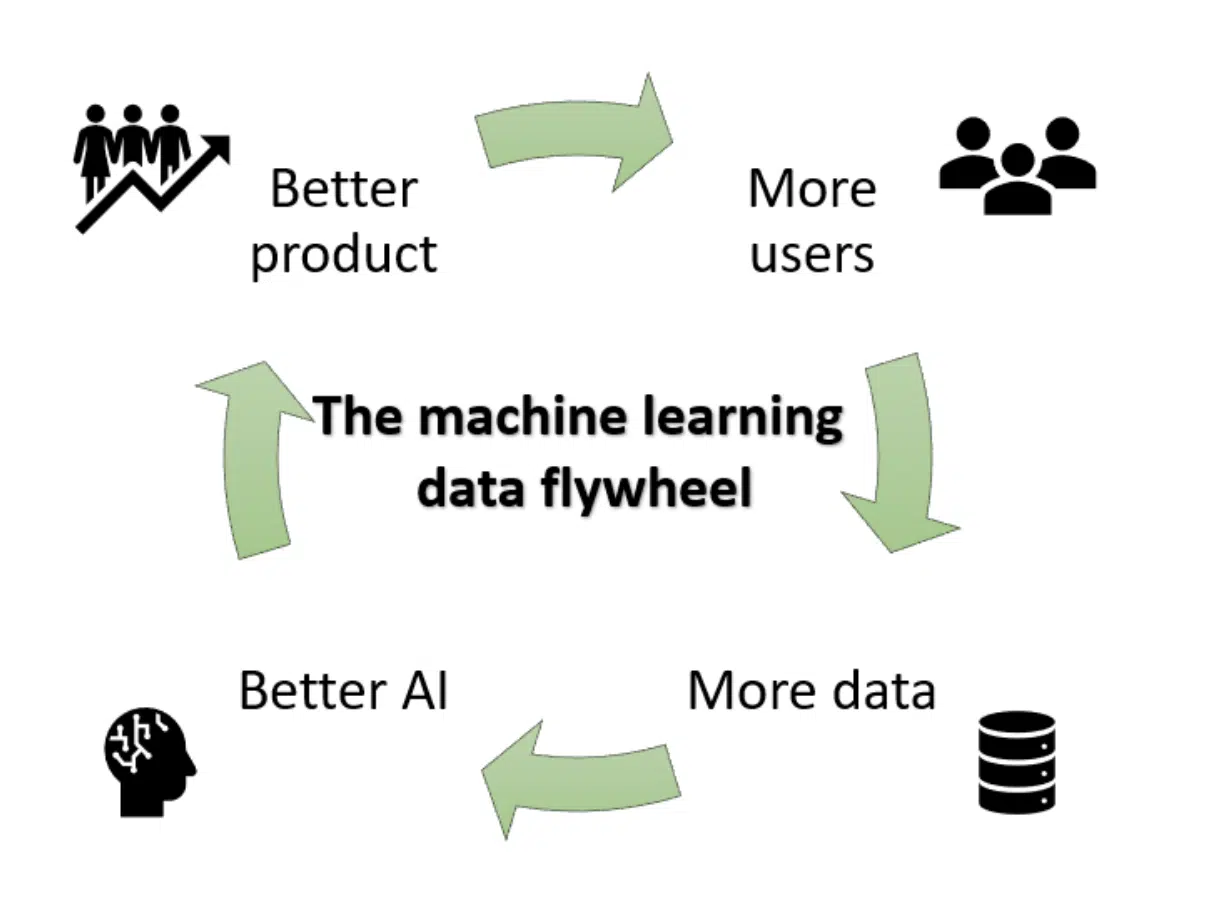
There's one exception worth naming: if you have a structural advantage that lets you leapfrog (usually distribution, an installed customer base, or a bundling story), you can afford to move second. Microsoft Teams overtaking Slack is the canonical pre-AI example, and the same playbook is already playing out in AI: incumbents with distribution catching up to AI-native startups by shipping "good enough" features to a customer base that was never going to switch anyway. If that's you, great. For everyone else, the data clock is ticking, as seen with the machine learning data flywheel.
What is an approachable way to build your first AI feature?
Get buy-in for financial investment before you begin building. You’ll likely need a team of 3–4 people (product, design, engineering, and data science) working on your first AI feature for a full year before you have a market-ready product. In addition to your initial team’s salaries, consider the cost of additional FTEs you might need to add and the risk of the project running over, especially if your team will be learning about AI when they begin.
Test an internal use case first – consider dipping your toes in the water by exploring an internal facing use case if your company is not yet ready to build a customer-facing AI feature. To do so, ask each of your functional team leads to identify existing tasks that their team considers to be time-consuming, tedious, boring, hard, etc. Then, consider whether you can automate those tasks by either:
- Buying an existing AI product (like Gong, which helps sales leaders coach their team to move deals forward faster)
- Building an internal product (like we did with our client HUNGRY, where we built an internal tool for CSMs to generate proposals faster and within margin guidelines)
How should you incorporate AI into your product strategy?
AI is a tool to help you realize your product strategy – don’t develop an AI strategy that’s separate from your product or company strategy because your overall product strategy should always determine how you leverage AI. To keep your product strategy top-of-mind, use a framework (such as our Vision-Led Product Management framework) that defines strategy as your multi-year plan to realize a customer journey vision. This vision should clearly lay out what you want your customer experience to look like in the future.

Consider the current and near-term possibilities that AI can help unlock – due to AI’s rapid progress, its capabilities are constantly changing. Regularly ask yourself the following questions, then update your customer journey vision and work backwards to define the strategic milestones (e.g., new data or features) that will let you bring that vision to life:
- What outcomes can you deliver to customers with AI in a way that was previously impossible, time-consuming, or both?
- What parts of your customers’ workflows can your product expand into with AI?
- Are you able to use AI and data to solve new problems for customers that would otherwise take them a long time to solve manually? Which problems could you help them solve?
Planning Your First AI Feature: the AI Product Strategy Pyramid
What do you need when building AI features? What is the Prodify AI Product Strategy Pyramid?
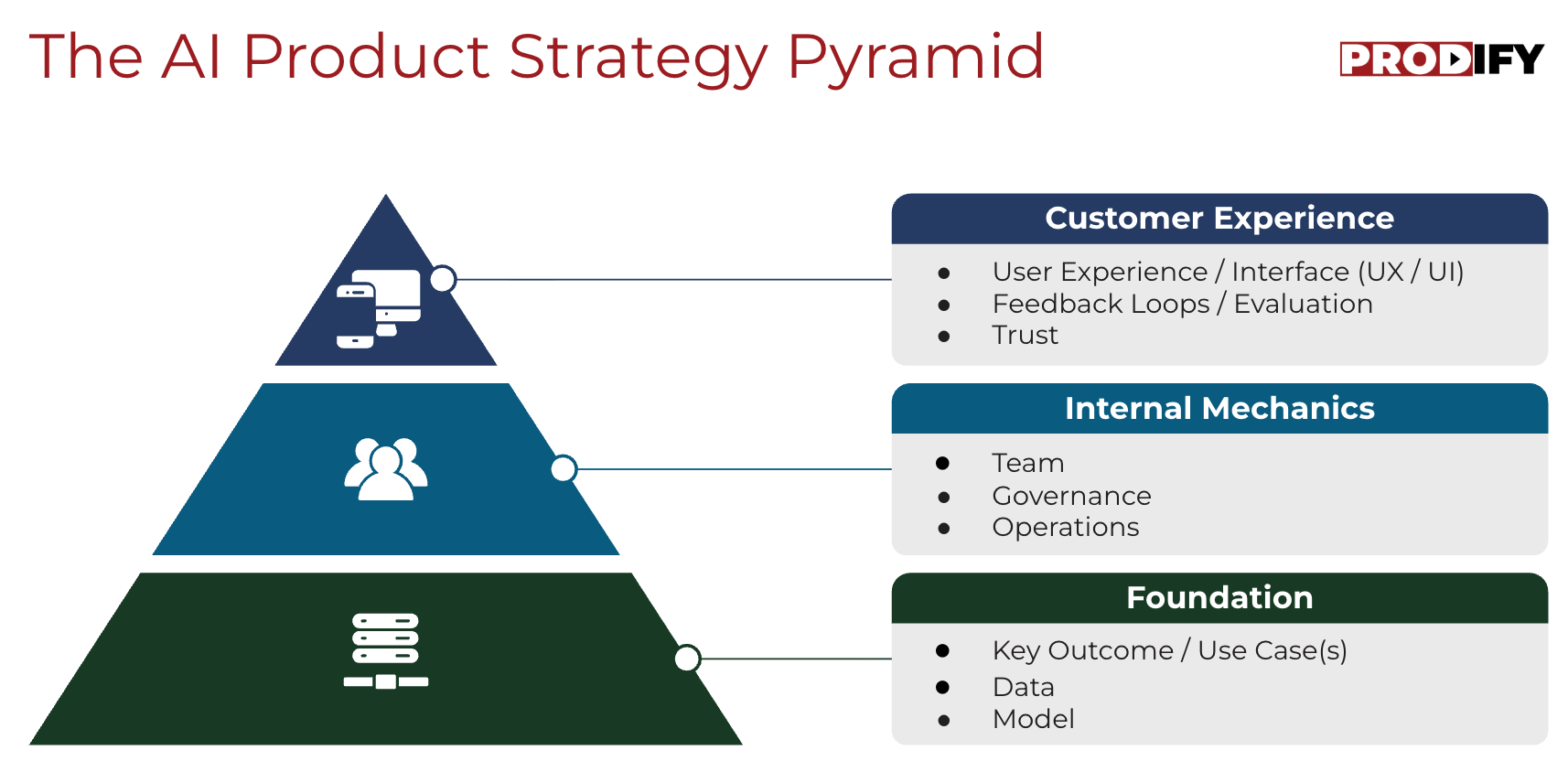
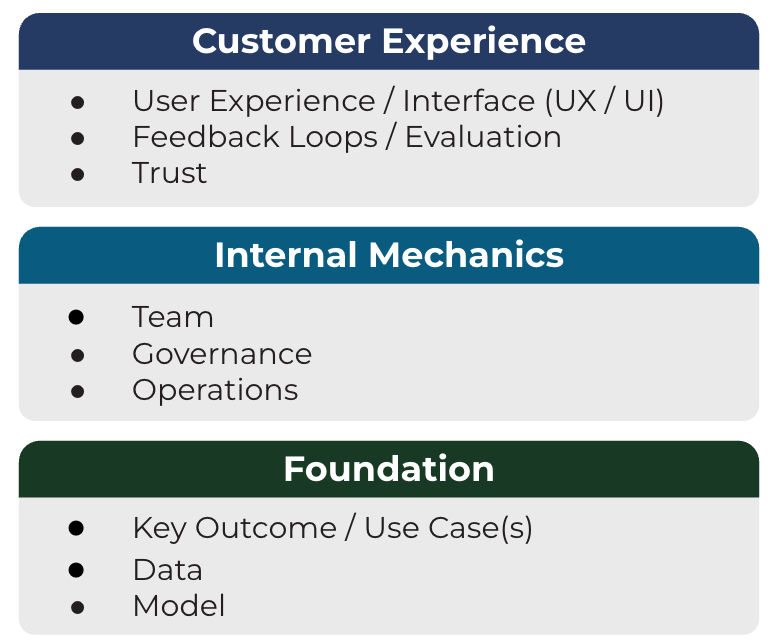
The Prodify AI Product Strategy Pyramid contains the prerequisites of a successful development process and release – each component of the Foundation, Internal Mechanics, and Customer Experience elements will help your team launch effective AI features.
The Foundation of your AI product strategy comprises 3 key elements:
- Key Outcome / Use Case(s) – start with the customer problem, which we call the key outcome. Identify the metric the customer is trying to improve. For example, key outcomes for B2B products usually revolve around ROI; you might set out to develop an AI product or feature that will help customers increase revenue or cut costs relative to what they spend on your product.
- Data – you need clean training data to teach the model what a great output looks like. This often requires significant work for data engineers to clear, tag, and streamline data pipelines.
- Model – Most teams should start by calling a hosted API from a major provider — it's faster, cheaper at low-to-moderate volume, and lets you swap models as the frontier moves. Self-hosting an open-weight model is the right call in a narrow set of cases: strict data-residency requirements, very high inference volume where per-token pricing has flipped against you, or edge/on-device deployment. If none of those apply to you, buy.
3 pillars of Internal Mechanics determine how your AI feature will actually be built and maintained:
- Team – many companies don’t have product managers, designers, engineers, and data scientists with AI experience because these skills are rare and command high salaries. If you’re not ready to hire a seasoned team, consider sending a “tiger team” (a small cross-functional squad that will build your first AI feature) to AI training or hiring an AI advisor/consultant to provide tailored hands-on training.
- Governance – there are myriad regulatory, compliance, ethical, and monitoring-based considerations when launching an AI feature – and errors in any of these areas can have severe consequences (e.g., the 2026 Pennsylvania lawsuit alleging Character.AI's chatbots posed as licensed medical professionals and provided unlicensed medical advice). Establish roles and responsibilities around designing, building, approving, and monitoring AI features internally. You also need to assign clear accountability for these features, and that accountability often falls to product managers.
- Operations – because AI models can generate a wide variety of responses, you must consider how to support AI features. You’ll also need to consider how AI features are tested during development and how to monitor and evaluate model responses in production.
The Customer Experience section of the pyramid determines how you will expose your AI model to customers (or users):
- User Experience / Interface (UX / UI) – chatbots are a well-known design pattern thanks to ChatGPT, but you should consider other patterns such as using traditional input forms but prepopulating data using AI, or removing steps from your existing workflow by automating them with AI. Consider how explainability can help build trust in your AI.
- Feedback Loops – no AI model is perfect. Feedback loops let your users provide input on whether the model’s response was clear, appropriate or accurate. Without this, the data flywheel we saw above won’t start spinning.
- Trust – AI might reignite data privacy and security concerns amongst your customers and users. Take a proactive approach to building trust with the user groups that come into contact with your AI feature. When appropriate, explain how you’re using and protecting their data.
Note: For a good example of how to use explainability to build trust in your AI, see how apps like Claude are transparent about what the model is doing as it progresses through a task.
How should you identify your first AI use case?
Use traditional product management techniques to understand customer problems – customer discovery interviews, market and competitive research, and surveys can help you identify which problems are most painful, and where existing solutions fall short in helping customers achieve the outcome metrics they seek.
Look for characteristics associated with good generative AI use cases, such as:
- Frequency – customer experiences the problem / situation often and has no workarounds
- Data – problem requires lots of data that you already have in your product (or could collect)
- Content – solution requires creating new content such as data, text, audio, images or videos
- Repetitive – users have to repeat the same action over and over, often based on the same logic
Example: personalized nutrition advice
Identify the problem – consider the consumer key outcome of losing weight. Nutrition is one factor consumers consider when trying to lose weight. However, nutritionists are hard to find, expensive, and always ask clients to tediously chronicle what they eat.
Consider the benefit AI could provide – an AI nutritionist could offer more personalized advice and meal plans at a lower cost and greater scale than a human nutritionist.
Determine whether the use case is compatible with what AI is best at – this is a good use case for AI because the product requires large amounts of data (e.g., diet, weight, sleep, exercise, etc.) but can quickly generate a personalized nutrition plan for each user.
How should you allocate resources toward your first AI feature?
Consider using a “tiger team” model – since AI is a new technology that your team might not be familiar with, it can be more efficient to allocate a finite number of your top performers to work on the first feature for a fixed amount of time (often 1 year for tiger teams with little to no AI experience). This approach allows you to right-size your investment based on your confidence in building an AI feature and the expected return from implementing the solution.
Example: right-sizing “tiger team” investment for an inexperienced team
Assess current skills – suppose nobody on your team has experience building AI features.
Build a lean, viable team – allocate 3–4 people to your “tiger team”: a product manager who can design and market the new feature, a full-stack engineer (or a front-end and back-end engineer), and a data scientist.
Estimate the cost of your time investment – suppose their annual salaries total $800k and they need 6 months to launch an alpha/beta version of a feature and a full year to launch into "general availability", where all your customers can access the feature based on a use case that was identified during your annual planning process. Your total investment for a full year would be $800k.
Evaluate Return on Investment (ROI) and determine whether your plan makes sense – compare the expected incremental revenue or cost savings from what the tiger team is planning to ship to see if it’s worth more than their time. So your investment is $400k to reach alpha/beta and $800k to reach general availability, if things look promising from the alpha/beta release. To calculate the return, conduct strategic customer discovery interviews to gauge customer willingness to pay to determine whether you should be able to generate a positive ROI. If you don’t think you can “invest proportionate to confidence” based on your current plan, adapt. You can choose a different time box if you are more or less confident (e.g., 3 months or 6 months instead of 1 year).
Building and Launching Your First AI Feature
How should you approach building your first AI feature?
Many aspects of building AI features are similar to building non-AI features – building an AI feature requires identifying the target audience and use case, providing product specs and designs to clarify scope, and building the feature itself.
AI features require significant data cleansing and organization – to feed data into an AI model and personalize the response for a given user, you’ll likely need to cleanse your data and organize it. “Garbage in, garbage out” applies to AI projects; it’s worth spending time to ensure that inputs to the model are accurate and can be used effectively to produce a better output.
In terms of integrating with a third-party model, there are 3 levels of personalization you can deliver:
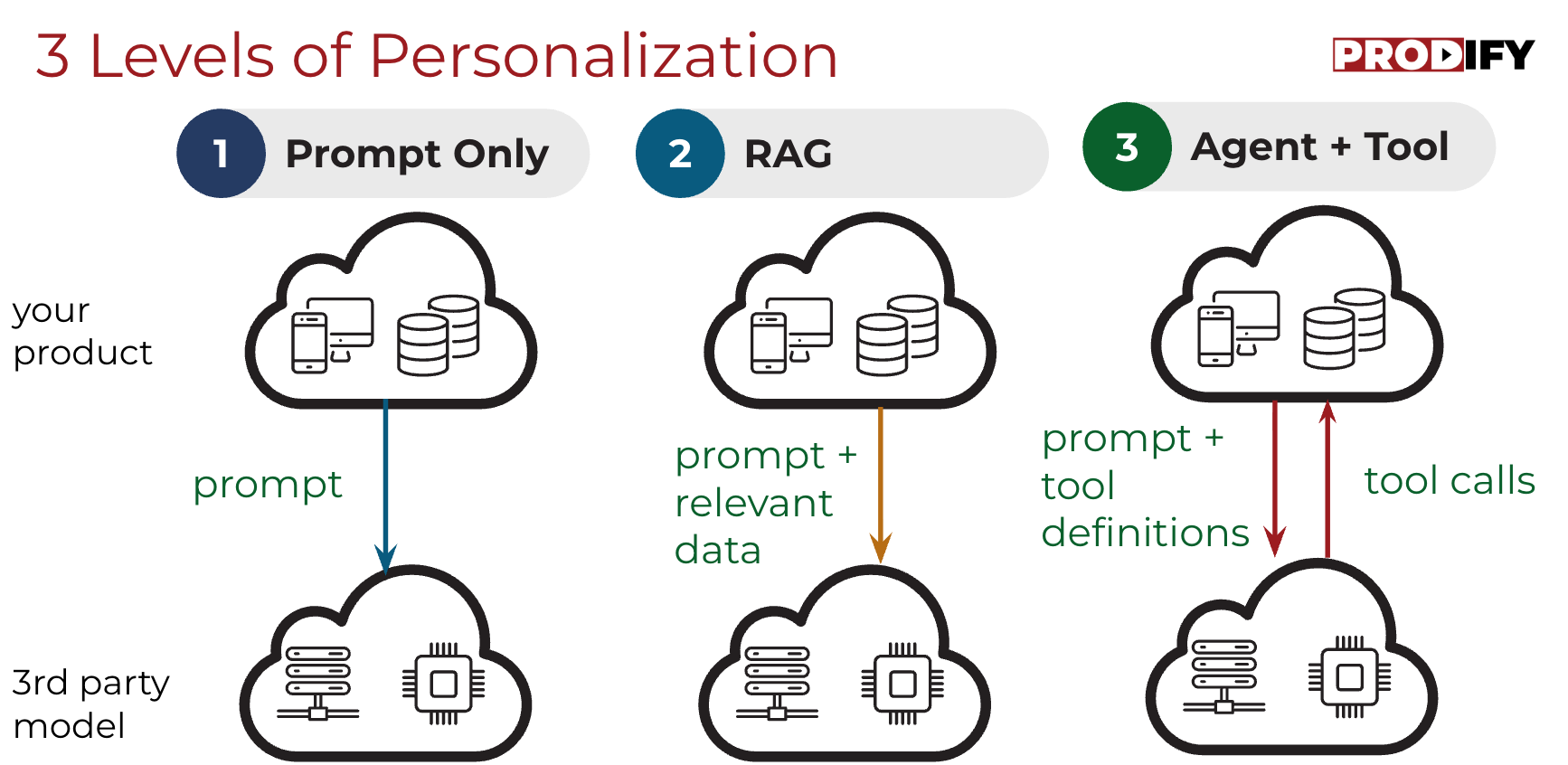
- Level 1: Prompt Only
- You send the model a prompt and rely on its pre-trained knowledge to respond. No proprietary data goes in.
- Nutrition app example: User asks, "What's a healthy 500-calorie lunch?" The model answers from general nutrition knowledge — same response any user would get.
- Best for: generic tasks where your data doesn't matter much.
- Effort: low / 1–2 months.
- Level 2: Retrieval-Augmented Generation (RAG)
- Your code retrieves relevant data from your product and passes it to the model as context. Your code decides what to fetch.
- Nutrition app example: User asks, "What should I eat for lunch today?" Your code pulls their recent meals, weight trend, activity, and dietary preferences, then passes it all to the model with the prompt. The model returns a recommendation personalized to that user.
- Best for: tasks where you know in advance what data the model needs. Covers most first AI features.
- Effort: medium / 2–3 months beyond a prompt-only feature.
- Level 3: Agents / Tool Use
- An agent is a model that doesn't just respond — it acts. You give it tools it can call (functions like
get_user_meals,log_meal, orsuggest_recipes) and let it decide which to use, when, and in what order. The model can chain multiple calls together to complete a task. - Nutrition app example: User says, "I'm trying to hit my protein goal this week — help me plan dinners." The model calls a tool to check the user's protein intake so far, calls another to see what's already in their meal plan, calls a recipe tool to find high-protein options, and proposes a plan. If the user replies "swap Tuesday for something vegetarian," the agent adjusts and re-plans.
- Best for: open-ended tasks, or anything where the model needs to do something (not just answer). Comes with real tradeoffs — more time to monitor and evaluate responses and the model's permissions need careful thought.
- Effort: medium-to-high / 3–5 months.
- An agent is a model that doesn't just respond — it acts. You give it tools it can call (functions like
A note on fine-tuning. A fourth level exists — retraining the model itself on your data. It's rarely the right move for a first AI feature in 2026. Better prompting, RAG, and tool use now cover most of what teams used to reach for fine-tuning to solve, at a fraction of the cost and complexity.
Employ regular sprint demos and status updates – keep internal stakeholders up-to-date on what the tiger team has done and learned. This helps stakeholders understand new impacts of the project and allows the team to course correct as needed. For example, your tiger team might have prototyped a model and realized they need a new data point from users, which might take extra time to build and integrate into the model.
How should you launch an AI feature?
Limit risk by using an alpha / beta / general availability release model – launch the feature to a limited subset of users to gather qualitative feedback and limit the risk of your model delivering incorrect or confusing responses before you roll it out to a larger user base. Make it accessible to 1–2 B2B customers or 100–200 D2C customers for the alpha release. While this might make your feature announcement less splashy, it will protect your reputation if something goes wrong.
Define success metrics before the launch – have a clear understanding of how you want your AI feature to help your customers and your company. After launch, measure those KPIs and report back to the team and stakeholders so you can evaluate performance and decide how to move forward. Examples of possible goals include:
- Trial or adoption (how many users try the AI feature)
- Repeat usage (how many users come back)
- Evaluation goals (what percentage of responses fall within the bounds of what you deem acceptable)
- Customer satisfaction (e.g., use a feedback survey – with a clear target for what “good” means, such as 4.5/5 stars based on at least 50 reviews – to determine whether you’re adding value for your customers)
After the Launch of Your First AI Feature
What should you do if you see great results?
A successful launch usually triggers additional investment – if the feature is still in alpha / beta, consider releasing it to more customers and/or iterating on user feedback to improve model accuracy and customer value.
Keep the ROI math in mind when increasing investment – if you want to expand your AI feature / program, you should see a clear reason to continue funding the AI squad. Leadership must also acknowledge that some of the squad’s future bandwidth will go toward maintaining the new AI feature and infrastructure, in addition to iterating on it or innovating with new AI features.
Consider expanding the team – if customers are responding positively, it might make sense to add more AI team members, such as a designer or marketer. If feedback, traction, and impact are significant, you should explore adding another cross-functional AI squad to build features in parallel to the first squad.
What should you do if you see lackluster results?
Understand the reason behind the poor performance – if the problem is a “quick” or simple fix (e.g., a marketing issue), it’s probably worth continuing your investment, iterating, and testing again. If a fundamental issue (e.g., a problem no one cares about, inability to get the right data, etc.) is preventing the feature from performing, you need to reassess whether the use case makes sense for your company at this time.
Primary reasons an initial AI feature fails its first release
These are the most common areas where AI features fail, with questions to consider for each.
Marketing
- Are users aware of this new AI feature?
- Was it clear how to try the feature when they logged into the product?
Use Case
- Did we choose the right use case?
- Did most users try the feature (suggesting there was demand for it)?
- Or, did we miss the mark on the urgency and importance of this use case / key outcome and build something no one cares about?
Solution / Experience
- Did users not trust our response?
- Was the UX confusing or buggy?
- Was something missing that made our feature less interesting than the current way users solve this problem?
Closing Thoughts
What are the most important things to get right?
Start with the customer problem or key outcome, then make sure AI is the appropriate solution – as with any feature, the ultimate goal is to ensure that you’re delivering value to customers and the business.
Document your data strategy – create a solid data foundation upon which to build your AI features. From the beginning, you should be asking how your experience will improve over time and how you can ensure that your data creates a moat that prevents competitors from copying your feature.
What are common pitfalls?
Checking the AI box – don’t just build a chatbot wrapper for ChatGPT and expect success. Customers and investors will see through this and be disappointed. The power of AI is using your data to build more personalized experiences, and any feature that leverages AI should deliver on that promise.
Assuming AI isn’t relevant to your business – don’t stick to a strategy that was created before AI matured. Just like you revisit your strategy when there’s a major market shakeup or regulatory change, you should revisit your product strategy in light of major technical advancements like AI.
Now what?
The teams that win with AI over the next few years won't be the ones who adopted it earliest or built the flashiest features. They'll be the ones who kept asking the oldest question in product management: what problem are we actually solving? and recognized when AI was the right answer.
Start the conversation this week or next. Start with the use case - is there an internal product where it'd make sense to launch the first AI feature? Do you already know of 1-2 customer use cases where AI would 10x the user experience? Add the topic of where AI fits into the product strategy to the next executive team meeting or roadmap planning call. And as always, reach out if you want to talk through your situation and see if Prodify can help guide you and your team.
Written by Rajesh Nerlikar
Rajesh is a co-founder of Prodify and currently serving as a Board Member. He is also the SVP of Product & Engineering at Optiwatt. Prior to that, he has more than 20 years of experience, serving as the VP of Product at Regrow. a fractional VP of Product at Savonix, the Director of Workplace Products at Morningstar, a Senior PM at HelloWallet (which was acquired by Morningstar) and a PM at Opower (which went public in 2014).
Recent Posts
Octopus Case Study: Rapid Experimentation
3 Tips for Managing a B2B2C Product
8 Ways to Organize Your Product Development Squads