
Client Case Study: Laying an AI Foundation to Drive Growth via Personalization
Contents
Recent Posts
Client Case Study: Laying an AI Foundation to Drive Growth via Personalization
Incorporating AI Into Your Product Strategy
From Projects to Products: How Best Egg Evolved Their Operating Model
Assessing the ROI of Your Product Strategy
How to Find Product-Market Fit in B2B2C: The Complete Strategic Guide
Related Posts
3 Tips for Managing a B2B2C Product
Storyblocks Case Study: The Effects of Vision-Led Product Management
DrFirst Case Study: Clarifying the Direction for a New Product
Consumer Health Case Study: Laying an AI Foundation to Drive Growth via Personalization
Last year, we worked closely with the product and engineering teams of a growth-stage consumer health company that was looking to add a recurring revenue stream on top of its existing one-time at-home test product. We helped shape their AI strategy, which relied on the at-home test results to personalize adaptive care plans. We also helped lay down the technical and operational infrastructure to help them integrate AI into their platform and product operations.
The Situation
Prodify co-founder Ben Foster worked with this company prior to this engagement as a fractional CPO, creating a culture of user-centric product thinking, teams and operations. This was early in the company’s lifecycle as they were launching the at-home testing product. After that product found traction, the CEO looked forward to how to build a recurring revenue stream to further fuel company growth. The most natural solution was to use millions of at-home testing results over years to build the intelligence to help customers find relevant products.
How We Helped
Subha Shetty helped our client with every layer of the Prodify AI Product Strategy Pyramid.
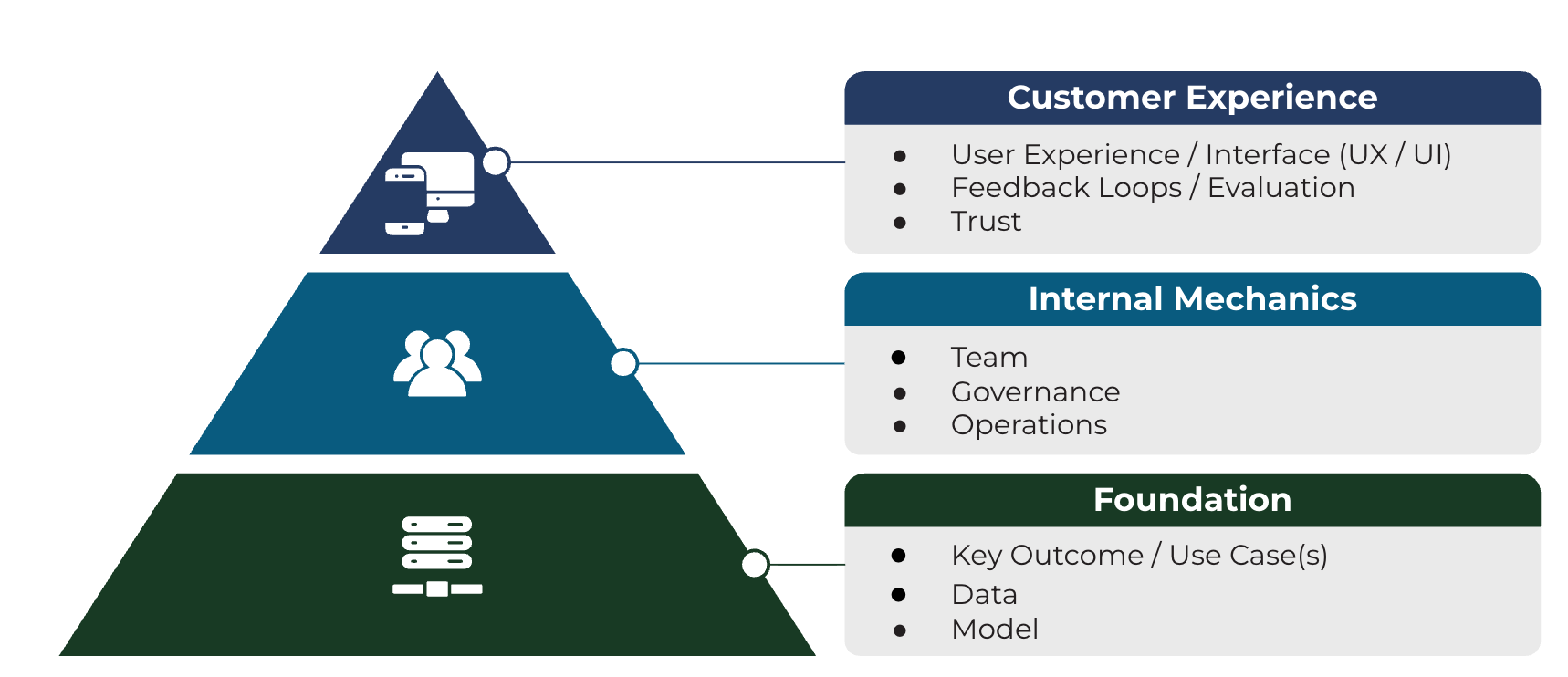
Foundation
As with any company that has a proprietary data set built over many years, this client’s foundation was based on the unique knowledge the at-home testing provided. Based on consumer insights on how customers were using those results to personalize their health decisions, we helped the company identify a few hypotheses to test for delivering ongoing customer value. These hypotheses included adaptive care plans, regenerative content, behavioral personalization, and personalized intervention sequencing. We also identified a roadmap of moonshot initiatives for later, uniquely positioned to leverage their data and for AI such as commerce, supplements and an agentic onboarding assistant.
Before testing those near-term hypotheses, Subha helped the company establish the data infrastructure to enable ML-driven prediction, LLM-powered communication, and long-term agentic personalization systems using best-in-class practices and her prior client and full-time experience implementing AI growth strategies.
Internal Mechanics
Once this infrastructure was in place, Subha guided the team to improve their product operations via AI-assisted planning, automated insight synthesis, and faster experimentation workflows. These new workflows allowed the team to run 5 times as many experiments as they were previously able to, generating new insights and data to validate the new product strategy and direction.
In addition to faster experimentation, Subha worked with the team to improve the trust and accuracy of their AI systems with better guardrails and evals. She also helped create the team’s governance model to include policies that would reduce hallucination and improve the quality of the customer support experience. They now include guardrails to ensure they’re using AI responsibly and policies to ensure customer safety and audit readiness.
Customer Experience
One of the key changes we helped them implement was creating a customer feedback loop to constantly improve the agentic flows and resulting customer experience. For example, customers could dislike a specific care activity recommendation and explain why, further helping the personalization model. LLM-generated explanations helped build trust with customers as they better understood where the care plan element came from.
The Results
With AI-assisted product operations, the team now runs 5x as many experiments as before. While the company is still executing on this strategy, early signals of customer demand are strong, and the growth projections look promising and realistic. They’re seeing more plans being created accurately without human intervention, increased adoption of care plan activities and interest in adaptive care plans, as signaled by customer referrals.
Key Takeaways for Building an AI Product Strategy
This is an example of a company that went beyond the common AI use cases we’re seeing: using AI to increase velocity, which often just exacerbates the feature factory dysfunction, or slapping an LLM onto an existing feature to check the AI strategy box. Some takeaways from this engagement:
- The best AI strategy is grounded in unique data. This client has proprietary information that allows them to find new ways to deliver key outcomes to customers while expanding lifetime value and preventing customers from switching to a competitor.
- A strong data pipeline enables AI growth. The company is already exploring new AI agents that can be built on top of the infrastructure created for adaptive care plans. This is an investment that will pay dividends for years.
- Safety is non-negotiable and not a bolt-on at the end. AI governance and safety mechanisms such as guardrails, evals and a holistic governance operating model improve the performance of the AI models and ultimately gains the trust of the consumers.
Written by Rajesh Nerlikar
Rajesh is a co-founder of Prodify and currently serving as a Board Member. He is also the SVP of Product & Engineering at Optiwatt. Prior to that, he has more than 20 years of experience, serving as the VP of Product at Regrow. a fractional VP of Product at Savonix, the Director of Workplace Products at Morningstar, a Senior PM at HelloWallet (which was acquired by Morningstar) and a PM at Opower (which went public in 2014).
Recent Posts
3 Tips for Managing a B2B2C Product
Storyblocks Case Study: The Effects of Vision-Led Product Management
DrFirst Case Study: Clarifying the Direction for a New Product